Software releases are moving faster than ever. New features, bug fixes, integrations, and updates are expected to reach users quickly without compromising quality.
But every release introduces risk.
A small code change can break an existing feature. An integration can behave differently in production. A bug that slips through testing can affect users, revenue, or even the reputation of the product.
This is where QA automation becomes valuable. Automated testing helps development teams continuously validate their software, identify problems earlier, and release updates with greater confidence.
What Is QA Automation?
QA automation uses testing tools and scripts to automatically verify whether software behaves as expected. Instead of a QA engineer manually repeating the same tests after every update, automated tests can check critical functionality whenever the application changes.
Depending on the product, automated QA can cover:
-
Unit testing
-
API testing
-
Integration testing
-
Regression testing
-
UI testing
-
Cross-browser testing
-
Performance testing
-
End-to-end testing
Manual testing still has an important role, particularly for exploratory testing, usability, and scenarios that require human judgement. The goal of automation isn't to eliminate manual QA. It's to automate predictable, repetitive checks so QA teams can focus their attention where human expertise matters most.
Why Software Releases Carry Risk
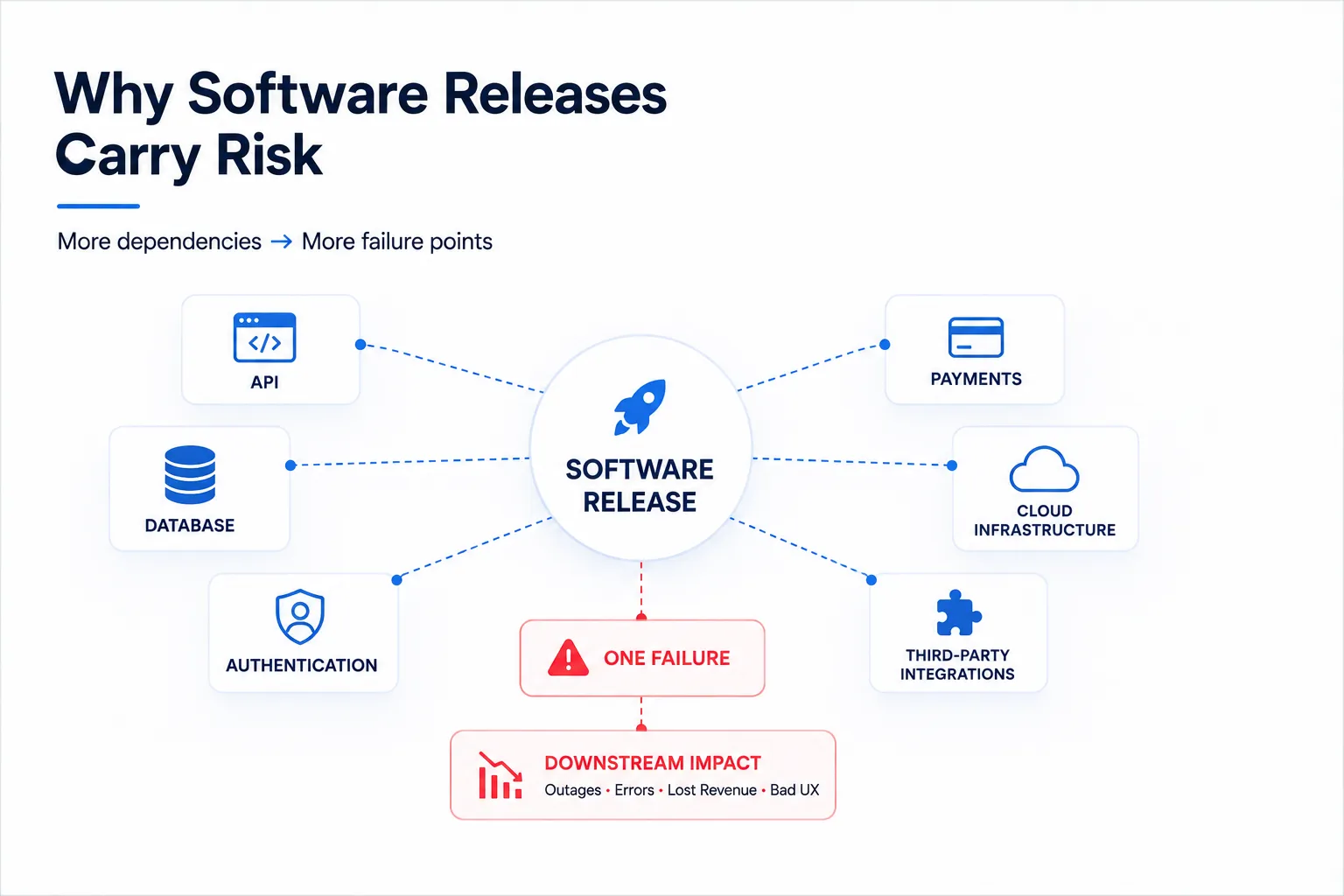
Modern software rarely operates as a collection of completely independent features.
Applications depend on APIs, databases, authentication systems, third-party platforms, payment gateways, cloud infrastructure, and numerous internal components. As the product grows, these dependencies become more complex. A developer might update one component without realising that the change affects another part of the application.
This creates several common release risks:
-
Existing functionality unexpectedly breaks
-
Critical user journeys stop working
-
API integrations fail
-
Browser or device compatibility issues appear
-
Performance deteriorates
-
Previously fixed bugs return
-
Production defects reach customers
When testing depends heavily on manual processes, checking all of these areas before every release becomes increasingly difficult.
How QA Automation Reduces Release Risk
1. It Catches Bugs Earlier
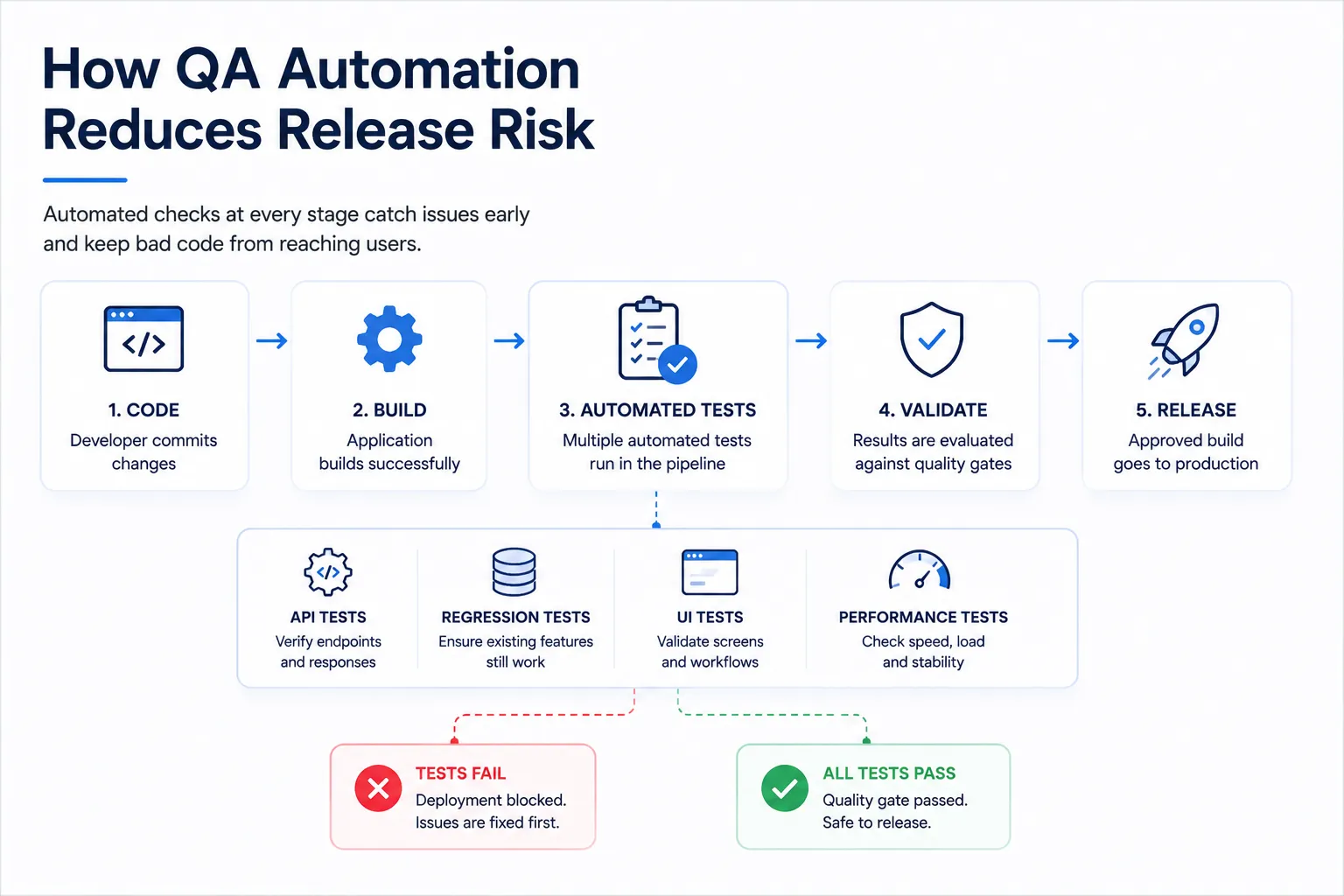
The later a defect is discovered, the more disruptive it can become. Automated tests can run whenever developers push new code through a CI/CD pipeline. If a change causes an existing test to fail, the development team receives feedback before the problem reaches production.
Developers can therefore address issues while the affected code is still fresh in their minds. Earlier detection also reduces the chance of multiple changes being built on top of faulty functionality.
2. It Makes Regression Testing More Reliable
Regression testing verifies that new development hasn't broken existing functionality. As a software product grows, manually retesting every existing feature becomes increasingly time-consuming.
Automated regression suites can repeatedly verify important workflows such as:
-
User registration
-
Login and authentication
-
Search functionality
-
Checkout processes
-
Payment workflows
-
Form submissions
-
API integrations
-
Account management
This gives teams greater confidence that new development hasn't damaged functionality that previously worked.
3. It Creates Consistent Testing
Manual testing can vary depending on the person performing the test, the available time, and the instructions being followed. Automation provides repeatability. The same test can run using the same steps and expected outcomes every time. This consistency is particularly useful for critical workflows that must function correctly before every release.
4. It Provides Faster Feedback to Developers
Development teams work more effectively when they know quickly whether a change has created a problem. Waiting until the end of a sprint for extensive manual testing can create a bottleneck.
With automated testing integrated into the development pipeline, developers can receive feedback within minutes of committing code.
The cycle becomes:
Develop → Test → Identify → Fix → Validate → Release
Shorter feedback loops help teams resolve defects before they become larger development problems.
5. It Reduces Human Error in Repetitive Testing
Repetitive manual testing is difficult to perform perfectly every time. A tester might unintentionally skip a step, overlook an edge case, or prioritise another area when release deadlines are tight.
Automation ensures that predefined checks aren't forgotten simply because the team is under pressure. This doesn't remove human judgement from QA. Instead, it lets people spend more time investigating unusual behaviour and product-specific risks.
6. It Supports Safer, More Frequent Releases
Without reliable automated testing, teams may hesitate to deploy frequently because every release requires significant manual verification. Automation changes the economics of testing.
If important functionality can be validated automatically, smaller releases become easier to manage.
Smaller releases also reduce risk because fewer changes are introduced at once. If something goes wrong, identifying the responsible change becomes much easier. For teams adopting Agile development, DevOps, or continuous delivery, QA automation becomes an important part of maintaining release velocity without sacrificing reliability.
7. It Improves Test Coverage
There is only so much testing a QA team can manually perform before a deadline. Automation allows teams to run hundreds or thousands of predefined checks across different areas of the application. Tests can also run overnight or alongside development activities.
This makes it possible to continuously check combinations of:
-
Features
-
APIs
-
Browsers
-
Devices
-
User journeys
-
Data inputs
-
Integrations
Greater coverage doesn't guarantee bug-free software, but it significantly improves the team's ability to identify predictable failures before release.
8. It Creates a Clearer Release Decision
One of the biggest challenges before deployment is answering a simple question: Is this version safe to release?
Without structured testing, that decision can depend too heavily on assumptions. Automated QA provides measurable evidence.
Teams can review:
-
Passed and failed tests
-
Regression results
-
Test coverage
-
Build status
-
Performance checks
-
Critical workflow validation
Release decisions become more informed because teams have clearer visibility into the current state of the product.
QA Automation and CI/CD
QA automation becomes particularly powerful when connected to a CI/CD pipeline.
A typical automated pipeline might look like:
Developer commits code → Application builds → Automated tests run → Results are evaluated → Approved build moves towards deployment
If a critical test fails, the pipeline can stop the release until the issue is investigated. This creates a quality checkpoint inside the software delivery process rather than treating QA as something that happens only after development is complete.
What Should You Automate First?
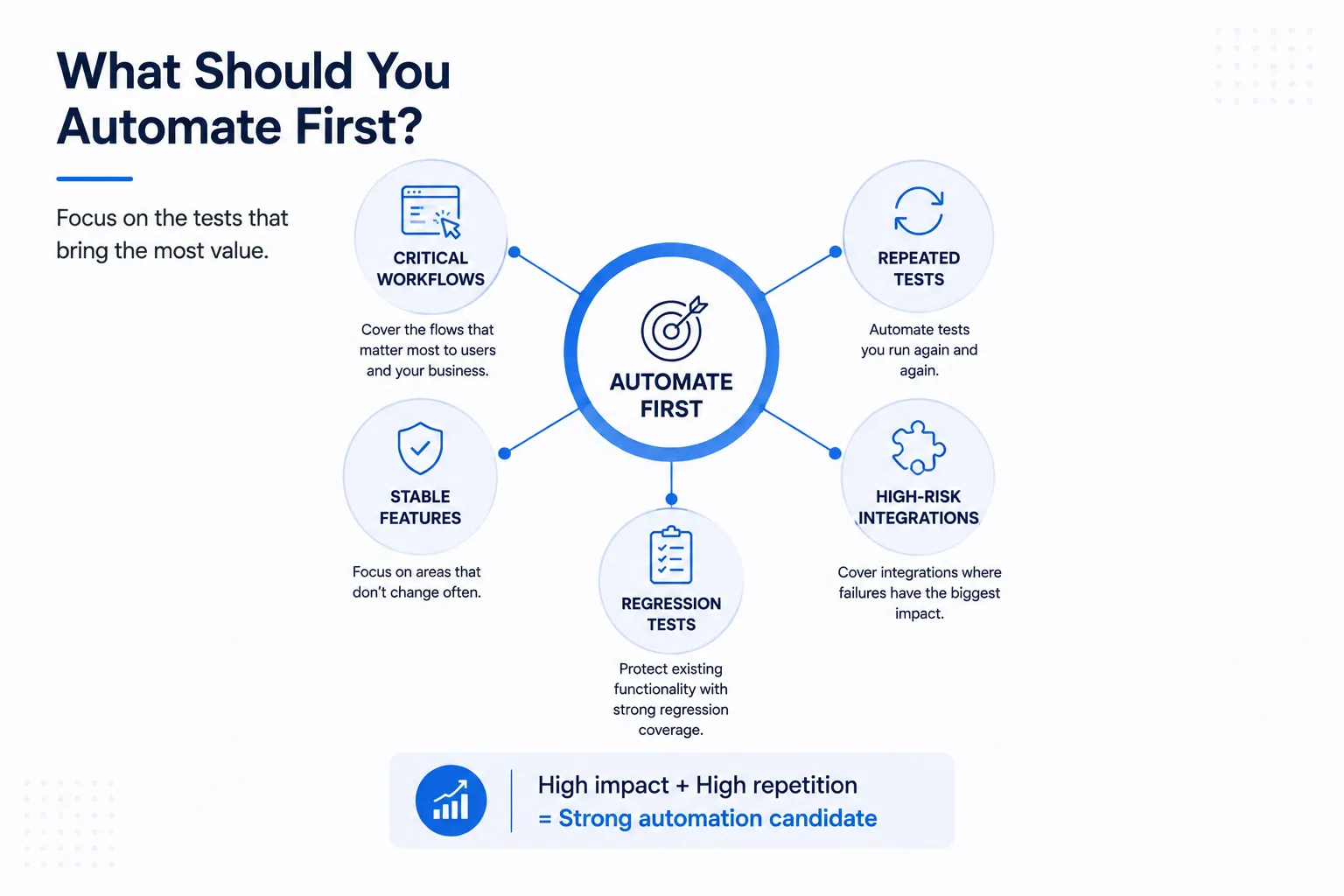
Trying to automate every test immediately is rarely the best approach. Start with tests that provide the highest value.
Good candidates usually include:
- Critical business workflows - Automate journeys where failure would directly affect users or revenue, such as checkout, payments, registration, or authentication.
- Frequently repeated tests - If the QA team performs the same test during almost every release, automation can provide significant time savings.
- Stable functionality - Features that don't change dramatically every sprint are usually easier to automate and maintain.
- High-risk integrations - APIs, payment gateways, authentication providers, and other important integrations can benefit from repeatable automated checks.
- Regression tests - Tests that confirm existing functionality remains intact are among the strongest candidates for automation.
What QA Automation Cannot Do
Automation isn't a guarantee that production defects will disappear. Poorly designed automated tests can create false confidence. Test scripts also require maintenance as the product evolves.
Some scenarios still benefit greatly from manual testing, including:
-
Exploratory testing
-
User experience evaluation
-
Visual inconsistencies
-
Unusual user behaviour
-
Newly developed functionality
-
Complex edge cases
The strongest QA strategy usually combines automated testing with skilled manual testing. Automation handles repeatability and scale. Human testers provide context, investigation, and judgement.
Building QA Into the Development Process
Quality shouldn't become a final checkpoint immediately before launch. It should be part of the entire software development lifecycle.
Development teams can reduce release risk by defining acceptance criteria early, building automated tests alongside features, integrating tests into CI/CD pipelines, reviewing failures quickly, and continuously improving the test suite. This approach shifts QA from "finding bugs before release" to "preventing unreliable software from reaching release."
Final Thoughts
Software releases will always involve some level of risk. The objective isn't to eliminate risk completely. It's to identify problems earlier, make quality measurable, and prevent predictable defects from reaching users. QA automation gives engineering teams a repeatable way to validate critical functionality throughout development.
When implemented properly, it can lead to:
-
Earlier defect detection
-
Faster developer feedback
-
Stronger regression coverage
-
More consistent testing
-
Safer deployments
-
More frequent releases
-
Greater confidence in production
For growing software products, QA automation and running tests faster, contact Rasonix now. It's about creating a development process where teams can move quickly without losing confidence in what they're releasing.







 Subscribe Now