Winning a new software project is exciting.
Realising your internal team doesn't have the capacity to deliver it is less so.
For UK digital, design, marketing, and software agencies, this creates a familiar choice: turn down the opportunity, hire more people, stretch the existing team, or outsource some of the delivery.
White-label outsourcing offers another option.
It allows an agency to use an external development team to deliver work behind the scenes while maintaining its own client relationship and brand.
Done well, the client experiences one joined-up agency team. Done poorly, outsourcing can introduce communication problems, inconsistent quality, missed deadlines, and uncomfortable client conversations.
This guide explains how white-label software outsourcing works, when UK agencies should consider it, how to choose a partner, and what makes the model successful.
What Is White-Label Software Outsourcing?
White-label outsourcing is an arrangement where an external software company delivers development services on behalf of another agency.
The agency remains the primary client-facing partner.
The outsourcing company works behind the scenes and may provide services such as:
-
Web development
-
Web application development
-
SaaS development
-
Mobile app development
-
Backend and API development
-
Third-party integrations
-
UI/UX implementation
-
QA and automated testing
-
DevOps and cloud support
-
Product maintenance
Depending on the agreement, the external developers may work completely behind the agency brand or collaborate directly with the end client as an approved extension of the agency's team.
How Does White-Label Outsourcing Work?
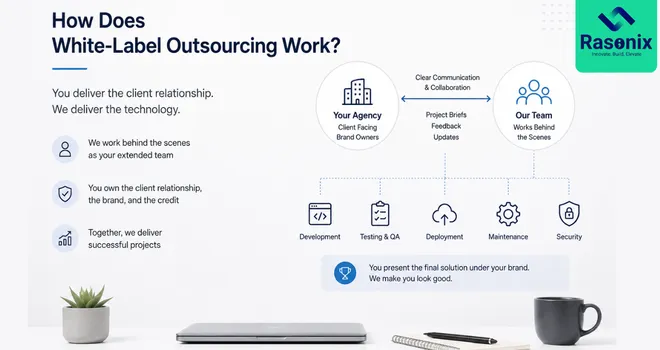
A typical engagement begins when an agency wins a project but needs additional technical capability or capacity.
The process may look like:
Agency wins project → Requirements are shared → Delivery team is assembled → Development begins → Agency reviews progress → Product is delivered to the client
The agency continues to manage the commercial relationship while the white-label partner handles some or all of the technical execution.
There are several ways to structure this relationship.
Project-Based Outsourcing
The partner delivers a defined project or technical scope for an agreed budget and timeline.
This can work well when requirements are relatively stable.
Dedicated Development Team
A team of developers is allocated to the agency for ongoing work.
This is useful when the agency regularly needs additional development capacity.
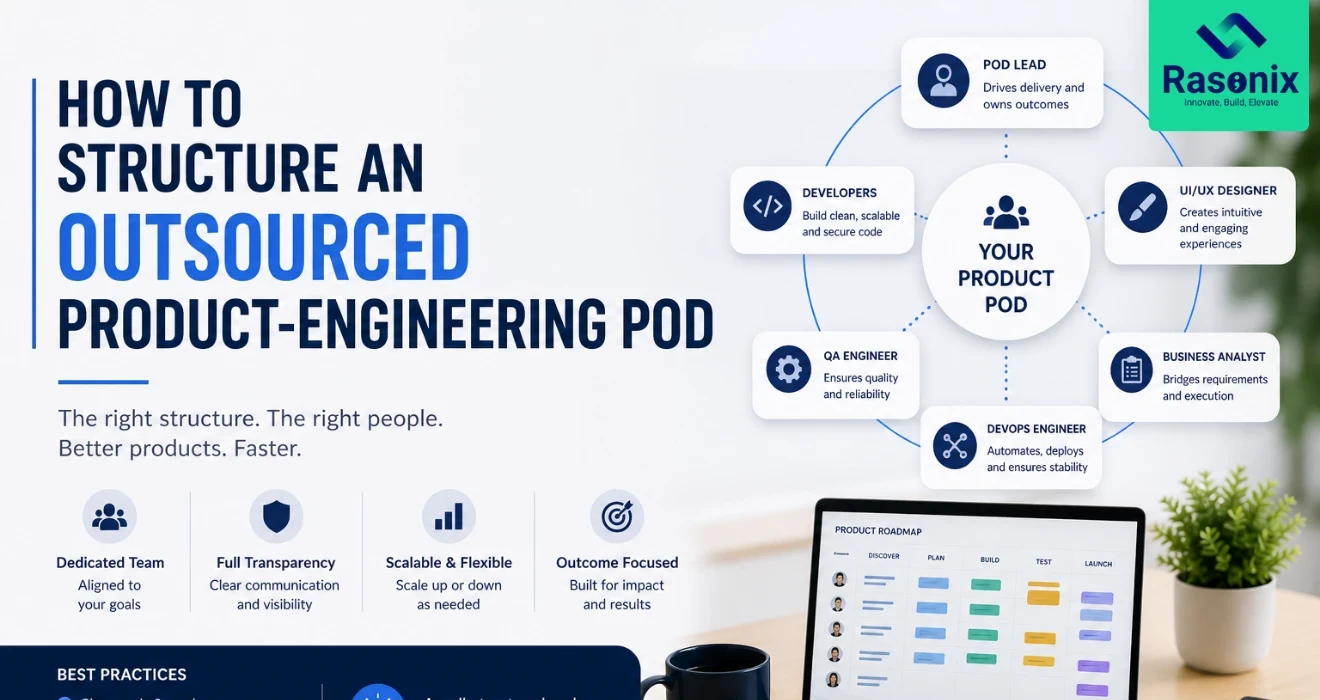
Product-Engineering Pod
A cross-functional team may include developers, QA engineers, designers, DevOps engineers, and technical leadership.
This product-engineering pod can suit larger software products requiring continuous delivery.
Specialist Support
The agency retains most delivery internally but uses an external partner for particular capabilities such as backend engineering, cloud infrastructure, mobile development, or QA automation.
The right model depends on how predictable the workload is and how much responsibility the agency wants its partner to take.
Why UK Agencies Use White-Label Development Partners
White-label outsourcing isn't simply about reducing development costs.
For many agencies, the bigger advantage is flexibility.
Take On More Projects
Internal development capacity shouldn't always determine how much new business an agency can accept.
A reliable delivery partner can provide additional capacity when the sales pipeline becomes stronger than the internal team's availability.
Expand Services Without Building Every Capability Internally
A design or marketing agency may have a client that suddenly needs a custom portal, SaaS product, mobile application, or complex integration.
Hiring an entire engineering function for one opportunity may not make commercial sense.
A white-label partner allows the agency to offer additional technical services without building every capability from scratch.
Scale Development Capacity
Agency workloads fluctuate.
One quarter might be relatively quiet. The next might bring several development projects simultaneously.
Permanent hiring for temporary demand can increase overhead.
Outsourcing allows agencies to scale development resources according to the workload.
Access Specialist Skills
Certain projects may require technologies or capabilities the existing team doesn't have.
Instead of recruiting for every specialist requirement, agencies can access skills when they need them.
Keep the Client Relationship
Turning down technical work can create an opportunity for another supplier to enter the account.
White-label development allows the agency to solve more of the client's requirements while maintaining ownership of the relationship.
White-Label Outsourcing vs Hiring In-House
Neither model is automatically better.
The decision depends on workload, skills, margins, and long-term plans.
|
Factor
|
In-House Hiring
|
White-Label Outsourcing
|
|
Recruitment
|
Required
|
Partner manages staffing
|
|
Fixed overhead
|
Higher
|
Typically more flexible
|
|
Scaling speed
|
Slower
|
Potentially faster
|
|
Specialist skills
|
Requires hiring
|
Available through partner
|
|
Workload flexibility
|
Lower
|
Higher
|
|
Direct control
|
Very high
|
Depends on engagement
|
|
Internal management
|
Higher
|
Shared with partner
|
If development demand is consistent and strategically important, building an internal team may be worthwhile.
If demand fluctuates or projects require different technical skills, a blended internal and external model may provide greater flexibility.
What Should a White-Label Development Partner Provide?
Not every software outsourcing company is suited to white-label agency partnerships. Agency work creates additional expectations because your own reputation is involved.
1. Reliable Technical Delivery
The fundamentals still matter.
Your partner should demonstrate strong capability across architecture, development, testing, deployment, and maintenance.
Review:
-
Previous projects
-
Technical case studies
-
Engineering experience
-
Code-review practices
-
QA processes
-
Development standards
-
Security practices
Remember that your client is unlikely to distinguish between your code and your partner's code. To them, your agency delivered it.
2. Clear Communication
Communication becomes particularly important when three parties may be involved:
Client ↔ Agency ↔ Development Partner
Unclear communication can quickly create delays.
Agree in advance on:
-
Communication channels
-
Response expectations
-
Meeting schedules
-
Project reporting
-
Technical escalation
-
Client-facing communication
-
Decision-making responsibilities
Your development partner should make communication easier, not add another layer of confusion.
3. Transparency
White-label doesn't mean invisible delivery.
The agency should still have clear visibility into what is happening.
You may need access to:
-
Project boards
-
Source-code repositories
-
Staging environments
-
Sprint plans
-
Technical documentation
-
QA reports
-
Design files
-
Deployment status
You should be able to confidently answer a client who asks: "Where are we with the project?"
4. Flexible Team Structure
Agency requirements can change quickly.One project may require two developers.
Another might require: Tech Lead + Developers + QA + DevOps + UI/UX. Look for a partner that can adjust the delivery team without forcing every project into the same structure.
5. Respect for the Agency-Client Relationship
This is one of the biggest considerations in white-label outsourcing.
Your partner needs to understand the commercial boundaries of the relationship.
Before starting, clarify:
-
Who communicates with the client?
-
Can developers join client meetings?
-
How should they introduce themselves?
-
Who owns commercial discussions?
-
Who handles change requests?
-
Who owns the client relationship?
These expectations should never be left to assumption.
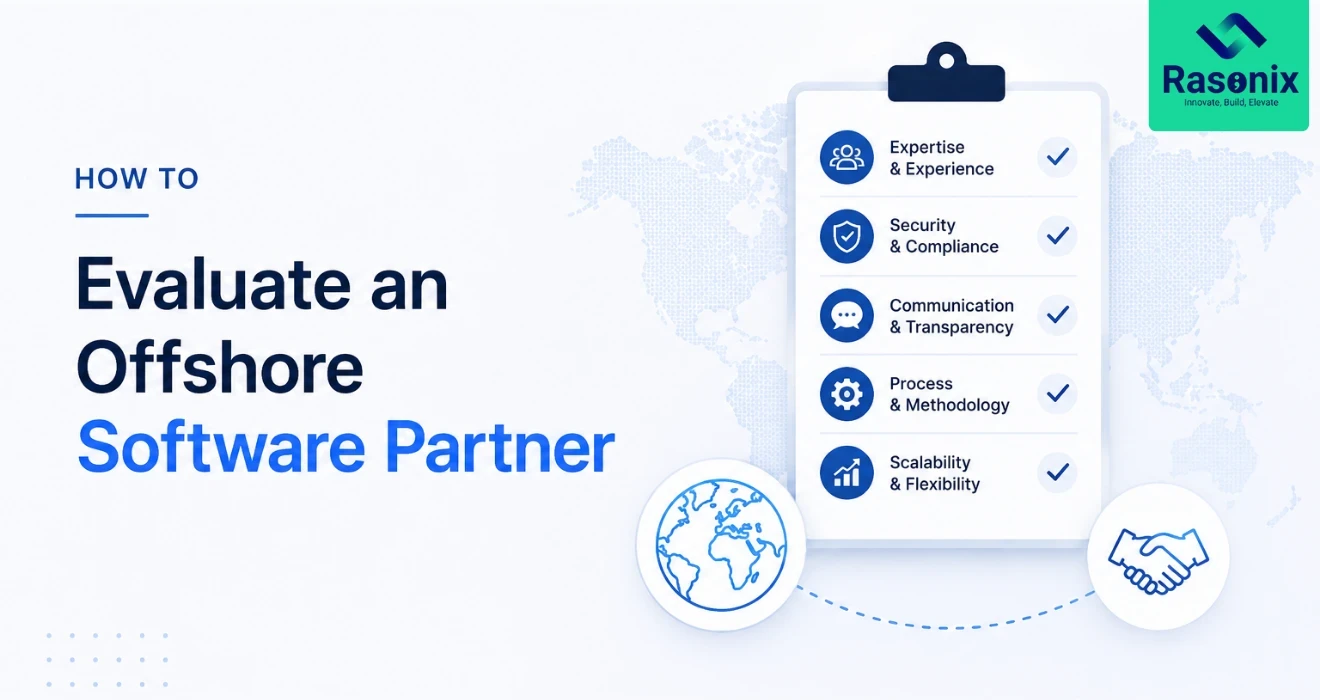
How to Evaluate a White-Label Software Partner
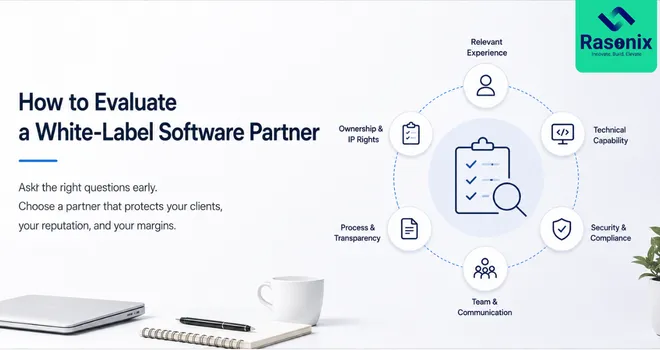
Before putting your agency's reputation behind another team, you have to evaluate an offshore partner carefully.
Review Relevant Work
Don't only look for attractive websites.
Look for projects involving similar technical complexity.
Ask what the partner actually delivered rather than assuming they were responsible for everything shown in a case study.
Meet the Delivery Team
Whenever possible, speak with the people likely to work on your projects.
This helps you evaluate technical knowledge, communication skills, and whether they could comfortably participate in client conversations if required.
Understand Their Process
Ask what happens from the moment requirements are received.
A structured process might include:
Discovery → Scope → Planning → Design → Development → QA → Deployment → Support
You should also understand how they manage changes when requirements evolve.
Ask About Code Ownership
Clarify who owns:
-
Source code
-
Designs
-
Documentation
-
Infrastructure configuration
-
Databases
-
Product IP
These terms should be established contractually.
Evaluate Security
Your partner may receive access to client systems, repositories, data, credentials, or infrastructure.
Understand how that access is managed.
Depending on the project, you may also need to evaluate relevant data-protection and compliance requirements, particularly where UK customer or employee data is involved.
How Should Pricing Work?
White-label partnerships need enough commercial room for both parties. Common models include:
Fixed Project Pricing
The partner provides a defined delivery cost and the agency adds its own margin before presenting the project to the client. This works best when scope is predictable.
Day or Hourly Rates
The agency purchases engineering capacity according to the amount of work required.
This provides greater flexibility but makes the final project cost less predictable.
Monthly Dedicated Team
The agency pays a recurring amount for an allocated development team or engineering capacity.
This can work well for agencies with continuous development requirements.
Whichever model you choose, calculate more than the development rate.
Consider:
Partner cost + Agency management + Risk allowance + Commercial margin = Client price
A project with no margin for management or unexpected changes can become commercially difficult even when development itself is delivered efficiently.
Protecting Your Agency's Margin
The cheapest outsourcing partner doesn't necessarily create the best margin.
Suppose one development team costs significantly less but requires constant supervision, produces inconsistent work, and regularly misses estimates.
Your internal team then spends additional hours managing the project.
The apparent saving disappears.
A slightly more expensive partner that delivers predictably may create better margins because your agency spends less time correcting delivery problems.
When comparing partners, consider total delivery cost, not simply hourly or monthly rates.
Managing UK–Offshore Time-Zone Differences
For UK agencies working with offshore engineering teams, time zones need to be managed deliberately.
You don't necessarily need eight hours of overlap.
You need enough overlap for important communication.
A practical workflow could include:
- UK Morning: Agency reviews overnight progress
- Shared Hours: Stand-ups, questions, technical discussions
- Offshore Afternoon: Development continues
- UK Afternoon: Agency manages client communication
With clear documentation and handovers, the time difference can become useful rather than disruptive.
How to Introduce an Outsourced Team to Clients
There isn't one correct approach.
Some engagements are completely white-labelled.
Others are transparent partnerships where the client knows external specialists are involved.
Choose the approach that fits your contracts, commercial model, and client expectations.
The important thing is consistency.
Everyone involved should understand:
-
How the development team is presented
-
Who leads meetings
-
Who approves scope
-
Who discusses budgets
-
Who communicates delays
-
Who handles support requests
Developers shouldn't have to improvise their role during a client meeting.
A Practical White-Label Delivery Workflow
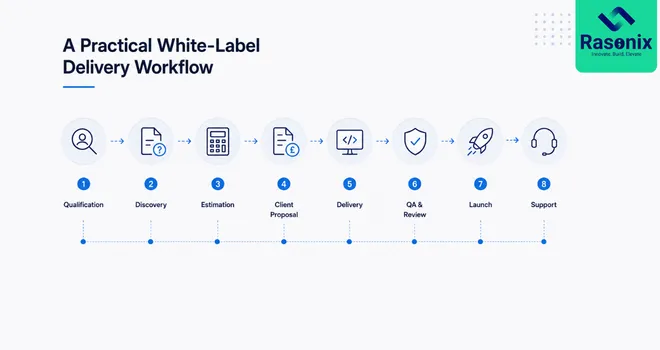
A structured workflow can reduce many common outsourcing problems.
Stage 1: Qualification
Confirm that the project fits the partner's technical capability, capacity, and timeline.
Stage 2: Discovery
Clarify requirements, users, integrations, risks, and technical constraints.
Stage 3: Estimation
Create a realistic scope, timeline, team structure, and delivery estimate.
Stage 4: Client Proposal
The agency packages the solution under its commercial model.
Stage 5: Delivery
Development progresses through agreed milestones or sprints.
Stage 6: QA and Review
Both the development partner and agency review the product before client acceptance.
Stage 7: Launch
Deployment responsibilities and launch procedures are coordinated.
Stage 8: Support
Agree who handles bugs, maintenance, infrastructure, and future development.
Common White-Label Outsourcing Mistakes
- Choosing Entirely on Price - Extremely low rates can become expensive when they create rework or management overhead.
- Hiding Delivery Problems - If a deadline is at risk, the agency needs to know early. Bad news doesn't improve with age.
- Unclear Responsibilities - Never assume someone else is handling deployment, QA, documentation, or client communication. Define ownership.
- No Internal Technical Oversight - Even with a strong partner, the agency should retain enough visibility to understand the technical health of the project.
- Overpromising Before Consulting the Delivery Team - Avoid committing to complex functionality or aggressive timelines before engineering has reviewed the requirement.
White-Label Outsourcing Checklist for UK Agencies
Before starting a partnership, confirm:
-
Relevant software development experience
-
Strong technical leadership
-
Clear communication process
-
Agreed UK working-hour overlap
-
Transparent project tracking
-
Source-code access
-
Defined QA process
-
Security and confidentiality expectations
-
Clear IP ownership
-
Client communication boundaries
-
Predictable pricing
-
Change-request process
-
Escalation procedure
-
Post-launch support
-
Capacity to scale when required
When White-Label Outsourcing Makes Sense
White-label development can be particularly useful when your agency:
-
Is turning down development work because of capacity
-
Wants to offer software development without building a large internal team
-
Has unpredictable project demand
-
Needs specialist engineering skills
-
Wants to protect client relationships
-
Needs additional developers for an existing team
-
Wants to expand into larger digital transformation or product-development projects
It isn't necessarily a replacement for internal developers. For many agencies, the strongest model is a combination of internal expertise and trusted external engineering capacity.
Final Thoughts
Your clients aren't hiring your outsourcing partner. They're hiring your agency.
That means the quality of your external development team directly affects your reputation.
The best white-label partnerships aren't built around finding the cheapest developers available. They're built around finding an engineering team you can trust with your clients, deadlines, technical decisions, and brand.
Look for a partner that provides technical capability, transparency, communication, predictable delivery, and clear commercial boundaries.
When those pieces are in place, white-label outsourcing becomes more than a way to fill temporary resource gaps.
It becomes a way for your agency to take on larger opportunities, expand its technical capabilities, and grow without increasing permanent overhead at the same pace.




 Subscribe Now